







For a growing number of organisations, carbon procurement is becoming less ad hoc. Internal teams are starting to adopt familiar procurement practices: defined requirements, cross-functional stakeholder buy-in, and decisions that need to hold up under scrutiny.
Yet, significant effort still goes into operational work: sourcing across fragmented supply, reconciling inconsistent information, benchmarking prices and coordinating approvals. After execution, teams still have to close the loop through settlement, retirement and documentation in a way that supports reporting requirements. These frictions are shared across the market, with transparency and data quality often cited.
As organisations move from one-off to multi-year purchases, the challenge is shifting from “can we buy credits?” to “how credibly can we run the process?”. This shift is where exchanges can play a role: not simply as a venue to find credits, but as market infrastructure that can reduce friction and support governance.
What exchanges unlock for corporate procurement
Most large buyers already have set procurement criteria. What slows procurement is often market friction: fragmented supply, limited price reference points and registry workflows that add effort both during evaluation and after selection.
Exchanges can help reduce friction by making carbon procurement easier to run as a repeatable process, rather than a one-off exercise each time. CIX, for example, is designed to support a more standardised procurement workflow from sourcing through to post-purchase handling.
Below are three common friction points – and how exchanges can address them.
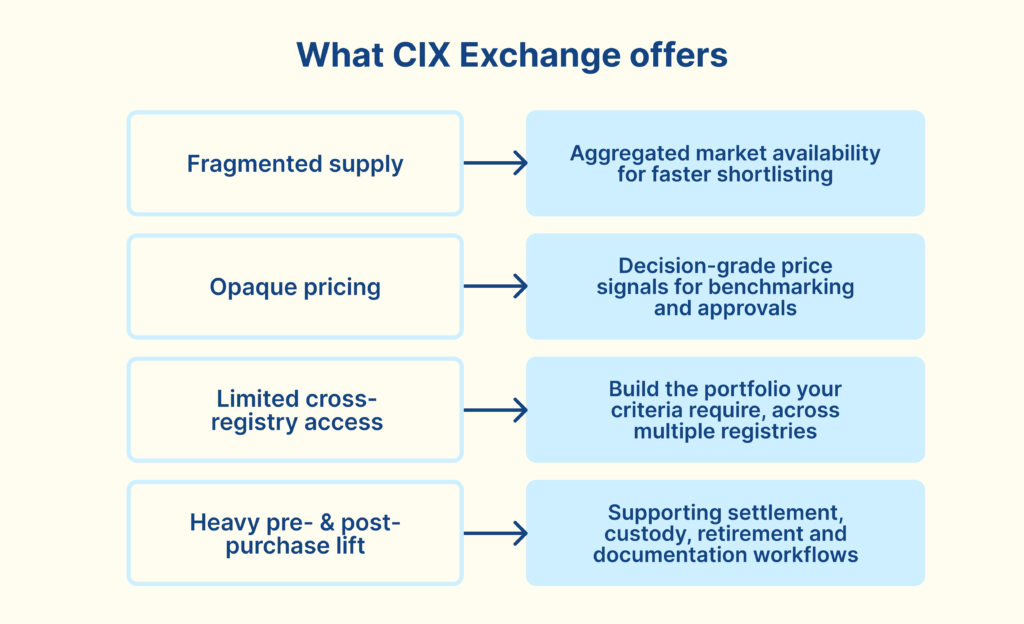
1) Supply fragmentation → faster shortlisting with fewer clarifications
The issue: In a fragmented market, teams may need to pull options from multiple sources and spend time reconciling information, clarifying project details, and verifying what is available – so options can be evaluated fairly against defined criteria.
How exchanges help: New issuances and secondary market availability can be viewed and compared within a single workflow.
Illustrative example: If a buyer is evaluating a nature-based project such as Katingan Mentaya, CIX can support the comparison of newly issued volumes alongside any secondary market availability on-screen. This reduces back-and-forth and enables teams to build a comprehensive shortlist much more effectively.

CIX Exchange
2) Pricing opacity → clearer reference points for decision-making
The issue: Carbon credit pricing can vary based on attributes such as methodology, geography, vintage, integrity signals and co-benefits. Buyers can receive a wide range of quotes that appear “comparable” at first glance. That dispersion creates work: validating whether differences are justified, explaining price drivers to stakeholders, and documenting why a chosen price is reasonable.
How exchanges help: Exchanges can produce decision-grade reference points derived from observable market activity. The goal is typically not to claim there is one “correct” price, but to help teams contextualise quotes within market ranges and explain variance using observable attributes.
Illustrative example: Pricing information such as that offered by CIX Intelligence can support benchmarking and speed up internal approvals. However, it’s important to note that they do not remove the need for diligence or attribute-based analysis.
3) Registry workflows → buying against requirements, not access
The issue: Execution can become a hidden bottleneck when registry access and workflows differ across project types and jurisdictions. These differences can affect how smoothly purchases can be closed out, as well as how consistently retirement evidence and documentation can be collected for internal reporting and disclosures.
How exchanges help: A centralised execution and post-purchase layer can reduce the operational burden of working across multiple registries – supporting settlement, custody, retirement and documentation workflows.
Illustrative example: With access to 12 registries and counting, CIX enables corporates to access, hold and retire eligible carbon credits or RECs, without needing to set up or manage their own registry accounts. In addition, CIX’s custody-like service also allows buyers to manage their purchases, retire credits and download certificates to support reporting requirements.
In Asia, these friction points are amplified by a diverse market landscape. Fragmentation, limited standardisation and integrity concerns are commonly raised barriers to scaling participation and mobilising capital.
For less standardised market environments, infrastructure can play an outsized role in helping buyers maintain consistent procurement standards even when underlying supply is diverse.
Closing: procurement outcomes are the new benchmark
Carbon procurement is entering a more mature phase. Expectations around transparency, comparability and governance are becoming more common, and market infrastructure is evolving in response.
For corporate buyers, the practical questions are shifting:
- Can we shorten cycle times without lowering standards?
- Can we validate pricing faster?
- Can we defend outcomes internally with confidence?
Exchanges are likely to play a meaningful role in this evolution. CIX is built to support the full transaction lifecycle – from portfolio curation to sourcing, execution and post-purchase processes – helping teams procure with greater consistency and control.