








As of April 2026.
Buying carbon credits or Renewable Energy Certificates (RECs), also known as Energy Attribute Certificates (EACs), is the easy part. The challenge lies in knowing which ones qualify for your sustainability reporting framework, sourcing them through a process that holds up to scrutiny, and pricing them fairly. The following guide addresses all three and how decision-makers can run a credible procurement process.
The guide is organised into four sections: a primer on why procurement strategy matters now, the instruments available to you, a step-by-step procurement framework, tapping into market intelligence and finally, sector-specific case studies. Throughout, you will notice that we link to our articles for deeper context per topic.
Table of contents
- Why your procurement strategy can’t wait
- Understanding your environmental instruments
- Carbon Credits
- Renewable Energy Certificates (RECs)
- Standardised Contracts and its benchmarks
- Building your procurement strategy
- Your procurement strategy in 5 steps
- Procuring in Asia
- Market Intelligence
- In practice: Industry spotlight & case studies
Why your procurement strategy can’t wait
Procuring carbon credits and RECs/EACs once had a clearer playbook: set a target, reduce emissions where you can, then buy and retire credits or certificates to close the gap. The pressures on that model have been building for years – and for many buyers in Asia, they’ve recently become impossible to ignore.
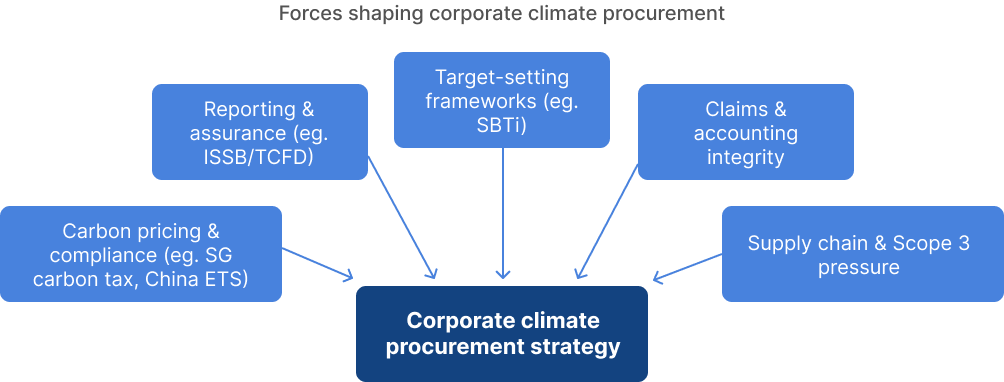
First, as carbon pricing mechanisms expand across Asia — from Singapore’s carbon tax and China’s national ETS to established cap-and-trade frameworks in South Korea and developing schemes in Japan and Indonesia — the cost of emitting is becoming a real line item on the balance sheet. That cost is increasingly felt beyond a company’s own operations too. Scope 3 targets are amplifying this pressure across value chains, with customers pushing suppliers to decarbonise while those suppliers face the same demands from their own customers. Carbon and REC procurement strategies must now be coordinated across finance, risk and sustainability functions.
Corporates need to secure credits that are not only cost-effective, but also eligible under regulatory and disclosure requirements. This is driving demand toward standardised products and more scalable procurement approaches, such as portfolio strategies and multi-year sourcing. Singapore’s carbon tax framework, for example, allows tax-liable facilities to use qualifying international carbon credits for up to 5% of taxable emissions — illustrating how jurisdiction-specific rules directly shape what buyers can and cannot procure.
Second, target-setting frameworks and claims rules are raising the bar on what counts as credible climate action — and this shapes procurement as much as compliance does. For corporate buyers, this means building a two-track procurement approach: one track governed by regulatory deadlines, eligible instrument types and jurisdictional rules; and a second voluntary track aligned to corporate net-zero targets.
On the voluntary track, credibility depends on which standards a company chooses to anchor its claims to. The SBTi’s Corporate Net-Zero Standard V2 remains under active revision, with the latest draft reinforcing ambition, transition planning and clearer treatment of low-carbon energy and ongoing emissions responsibility. Market-based claims continue to depend on accounting rules such as the GHG Protocol Scope 2 quality criteria, which require contractual instruments to be retired, matched to the inventory period, and sourced from the same market as the reporting company.
At the same time, voluntary claims frameworks are getting more specific. The Voluntary Carbon Markets Integrity Initiative (VCMI) Claims Code of Practice provides a structured pathway for companies to make credible carbon credit claims, with independent third-party verification built into the process. In Singapore, Singapore Sustainable Finance Association (SSFA)’s forthcoming corporate claims guidance, developed in close coordination with the government’s VCM framework, is providing Asia-based corporates with a complementary set of rules for how credits can be used as part of a credible decarbonisation plan. Both are setting clearer rules for what qualifies as a credible climate claim.

The companies that treat procurement as a structured recurring discipline, rather than a reactive compliance exercise, are building a durable advantage: lower procurement costs through better price discovery, stronger claims through documented quality controls and reduced regulatory exposure through audit-ready processes.
The articles below explore what these shifts mean in practice. The first examines how to navigate carbon tax as a strategic opportunity, using Singapore as a case study. The second draws on webinar insights on the SBTi’s V2 draft standard and what it means for your climate programme.


Understanding your environmental instruments
Before building a procurement strategy, you need to know what you’re buying and why. Carbon credits and RECs are not interchangeable. They address different parts of your emissions footprint, operate under different standards and carry different reporting implications. This section explains each instrument and how they fit together.
A. Carbon Credits
A carbon credit represents one tonne of CO₂ equivalent either avoided, reduced or removed from the atmosphere, verified by an independent third party and issued on a registry. They come in two broad types: avoidance and reduction credits, which prevent emissions that would otherwise have occurred (e.g. protecting a forest, capturing methane from landfill), and removal credits, which actively draw down carbon already in the atmosphere (e.g. biochar, direct air capture, mangroves). In a corporate decarbonisation strategy, credits are typically used to address residual emissions — the emissions that remain after a company has reduced what it can through operational changes and renewable energy procurement.
Below are some perspectives CIX has published on specific project types covering their climate mitigation impact, integrity considerations and what buyers should know before procuring.




Procure the right carbon credits with guidance from a CIX expert
CORSIA
CORSIA — the Carbon Offsetting and Reduction Scheme for International Aviation — is a compliance framework administered by the International Civil Aviation Organisation (ICAO). CORSIA-eligible credits are not a project type: they are credits that meet a specific set of eligibility criteria defined by ICAO, making them acceptable for use by airlines to offset emissions above a set baseline. If you operate in aviation or work with aviation-adjacent supply chains, the window to secure CORSIA-eligible credits at current prices is narrowing as regulatory deadlines approach and eligible supply tightens.
At CIX, we support airlines and other market participants looking to secure CORSIA-eligible credits. Our CORSIA Phase 1 X- Global Markets (CP1X-GM) standardised spot contract and benchmark help improve price discovery, transparency and access in the CORSIA market, giving buyers a clearer reference point when planning procurement strategies.
We’ve written a dedicated buyer’s guide to CORSIA and hosted a webinar earlier last year on the risks, uncertainties, and integrity considerations shaping the CORSIA market.
Head to our dedicated CORSIA page here.



B. Renewable Energy Certificates (RECs)
A REC, also referred to as an Energy Attribute Certificate (EAC) or, in Europe, a Guarantee of Origin (GO), represents the environmental attributes of one megawatt-hour of renewable electricity. It enables a company to make a market-based Scope 2 claim under the GHG Protocol by purchasing and retiring the certificate, even if its physical electricity supply is not directly renewable.
The credibility of that claim depends on certificate quality (source, vintage and certification standard) and on whether it sits within the same market boundary as the electricity being consumed. A certificate sourced from a different country or grid will, under most recognised standards, not support a market-based Scope 2 claim.
Evolving buyer expectations
Most companies today still rely on annual, volume-based matching using unbundled certificates. However, proposed updates to the GHG Protocol are shifting the market toward more granular, hourly matching, which requires your renewable generation to align with exactly when and where you consume power. For example, if your facility consumes 10 MWh at 3:00 PM on a Monday, you would retire high-integrity unbundled RECs generated during that specific window in that specific location. These certificates remain a critical, audit-ready tool for meeting your evolving Scope 2 requirements. The market is now differentiating more clearly between certificates that provide this level of granular, audit-ready data and those that do not.
If you’d like to explore RECs in more detail, we’ve written a number of articles on REC procurement, market boundaries and renewable energy strategy below.



CIX can support your Scope 2 strategy with internationally verified RECs
C. Standardised Contracts and CIX benchmarks
In environmental markets, standardised contracts define a common set of specifications for the environmental asset being traded. These specifications typically include eligibility criteria, registry requirements, vintage parameters and delivery terms. By setting these parameters in advance, market participants can trade the same instrument rather than negotiating the underlying characteristics of the asset for each transaction. This creates a consistent reference point for both buyers and sellers.
Standardisation can improve market transparency and price discovery by concentrating liquidity into a single contract. For buyers, this makes it easier to understand prevailing market prices and incorporate those signals into procurement planning and internal carbon budgeting.
CIX’s standardised contracts provide a common framework for trading environmental assets on exchange, reducing negotiation friction, shortening transaction timelines and supporting transparent price discovery.Trading activity in these contracts informs CIX benchmark prices, which are market-representative reference points that corporate buyers can use for budget planning, supplier negotiations and mark-to-market valuations. These market signals are published in CIX’s market intelligence reports and updated regularly to reflect live market conditions.
Our standardised contracts include:
| Code | Contract name | Market scope |
|---|---|---|
| CNX | CIX Nature X | Nature-based avoidance – Reducing emissions from deforestation and forest degradation (REDD+) |
| CCX | CIX Cookstoves X | Improved cookstoves |
| CAX | CIX ARR X | Nature-based removals – Afforestation, Reforestation and Revegetation (ARR) |
| CP1X-GM | CIX CORSIA Phase 1 X – Global Market | CORSIA Eligible Emissions Units for the 2024-2026 compliance period (first phase) |
All of these standardised spot contracts are live to trade on CIX Exchange, including our latest benchmark contract, the CIX CORSIA Phase 1 X – Global Markets (CP1X-GM).
Explore all our standardised contracts here.

Building your procurement strategy
Knowing which environmental instruments are available in the market is the starting point. The harder task is designing a procurement strategy that is credible, repeatable and auditable — one that links purchasing decisions directly to climate targets, financial planning and reporting obligations.
Environmental asset procurement now sits at the intersection of sustainability, finance and risk management. Companies must decide not only what to buy, but when to buy, how to source it, how to assess quality and how to make credible claims against their purchases.
The five steps below outline a structured approach used by many corporate buyers, moving from objective-setting through procurement design, sourcing and execution.
| Step 1 | Step 2 | Step 3 | Step 4 | Step 5 |
|---|---|---|---|---|
| Define your objectives and constraints | Design your procurement strategy | Choose your sourcing pathway | Execute and settle | Retire, document and report |
Step 1 — Define your objectives and constraints
Before you approach any market or issue an RFP, companies should first define why they are procuring environmental assets and what constraints shape that decision. Procurement strategies typically sit at the intersection of policy, emissions exposure and financial planning.

Climate and reporting commitments

Emissions coverage

Budget and procurement horizon
Climate and reporting commitments
Environmental asset procurement is often driven by formal climate commitments or disclosure frameworks. These frameworks define what companies are allowed to claim, which instruments qualify and how they must be documented. Examples include:
– meeting GHG Protocol Scope 2 targets
– benchmarking to ICVCM Core Carbon Principles
– aligning with SBTi net-zero pathways
– preparing for ISSB-aligned climate disclosures
– addressing obligations under carbon pricing regimes
Each framework carries different requirements for instrument eligibility, vintage, documentation and geographic boundaries. For example:
– Scope 2 accounting requires market-matched RECs
– Net-zero frameworks require that credits address residual emissions only after abatement
– Compliance schemes may restrict which registries or project types are eligible
Because these frameworks shape how environmental claims are verified, your procurement decisions often involve coordination across sustainability, finance, legal and procurement teams. Establishing the eligibility criteria for purchases, particularly under regulatory frameworks, can take several months of internal review before procurement even begins.
Emissions coverage
Once your climate commitments are defined, the next step is determining which emissions the procurement strategy is intended to address. These commitments typically specify which emissions must be reduced, replaced with renewable energy, or addressed through environmental assets. Examples include:
– Scope 2 electricity consumption
– residual Scope 1 or Scope 3 emissions
– compliance obligations such as carbon taxes
– voluntary climate commitments or beyond value chain mitigation
This determines whether the comapany needs carbon credits, RECs, or both, as well as the timing and structure of procurement. Many companies therefore operate multiple procurement tracks simultaneously — for example, renewable electricity procurement for Scope 2 and carbon credit procurement for residual emissions.
Budget and procurement horizon
Procurement is ultimately a financial decision and should be aligned with internal budgeting processes. In practice, companies tend to use one or more of the following planning lenses:
Annual purchasing budgets. Many organisations work within a fixed annual budget and purchase environmental assets within that envelope. Under this model, procurement volumes are shaped by what can be funded within the year’s approved budget rather than the full emissions footprint.
Internal carbon pricing models. Some organisations use internal carbon pricing to translate their emissions footprint into a financial planning tool. For example, assuming US$50–100 per tonne of CO₂ helps estimate the investment required to meet climate targets and plan procurement budgets.
Multi-year investment plans. Companies with formal net-zero pathways use forwards to hedge price and supply risks. Planning beyond a single year better aligns procurement with long-term climate targets with a deliberate portfolio.
Together, these planning lenses shape whether procurement happens opportunistically, annually, or through a structured long-term portfolio strategy.
Procurement strategies must also reflect internal realities: who owns the process, how decisions are approved and what must be documented. These constraints shape how quickly procurement can move and whether decisions will hold up under review or assurance.
Key questions to define upfront:
- Who owns environmental asset procurement: sustainability, finance or procurement teams?
- What approval thresholds apply to large purchases?
- What documentation is required for reporting and assurance?
Step 2 — Design your procurement strategy
Once your objectives and constraints are clear, procurement strategy design focuses on how procurement will operate in practice. This is where companies define how purchases will be structured, how risk will be managed and how decisions will be governed internally. Below are five dimensions to consider.
1. Procuring criteria
Before approaching the market, buyers should define what constitutes an acceptable purchase. This means setting a clear rulebook for what can be bought, what evidence is required, and what falls outside scope under the organisation’s reporting framework or internal policy. This is also where integrity needs to be built into the strategy, rather than treated as an afterthought. In practice, the criteria often differ by instrument:
- For carbon credits, buyers may focus on defining project type, methodology, registry, additionality, geography, vintage and co-benefits where relevant.
- For RECs, buyers may focus on issuing standard, market boundary, vintage and whether it can support the intended Scope 2 claim.
For companies reporting under more formal frameworks, this matters even more as buyers may need to evidence not only what they purchased, but why that asset was eligible for the claim being made.
2. Purchase profile
Buyers need to decide what kind of purchase they are willing to make and how often they intend to buy.
For carbon credits, this often means choosing between pre-issuance and post-issuance volumes. Pre-issuance structures may offer earlier access to supply or more attractive pricing, but they also require greater tolerance for delivery uncertainty and project-performance risk. Post-issuance purchases offer more certainty because credits have already been issued, but usually less flexibility on price, timing and access.
Frequency matters as well. Some organisations buy on an ongoing basis as part of a recurring programme, while others make one-time purchases tied to a specific reporting cycle, target year or tender. Some buy in smaller tranches throughout the year, while others consolidate procurement into a defined window.
Together, these decisions shape the level of certainty the programme requires, how structured procurement is likely to be and how far ahead the organisation is willing to commit.
3. Management approach
Companies also need to decide how much of the process they want to manage internally, which depends on internal capacity, governance requirements and the complexity of the programme. Some organisations run sourcing, evaluation, transaction handling, settlement, holding, and retirement themselves. Others use an outsourced or hybrid model, relying on an external partner for market access, transaction execution, settlement, custody-like holding, retirement support, or reporting.
A company building its programme for the first time may prefer an outsourced approach that reduces operational burden while still preserving visibility and governance.
This is also where buyers decide how they want to interact with the market in practice. Procurement may be managed through a combination of online and offline workflows.
At CIX, for example, buyers can choose between digital and bespoke workflows and use us for different parts of the process depending on how much they want to manage in-house. Read more about the different sourcing channels at Step 3.
4. Risk management
Like procuring for any other asset, there are several forms of risk to look out for, including:
- Quality risk: The risk that purchased assets fail to meet reporting or integrity standards
- Supply risk: The possibility that supply becomes constrained
- Price exposure: Market conditions move over time
- Counterparty risk: Delivery, settlement depends on supplier reliability
Good procurement design makes these risks visible and manageable in advance. This often means defining supplier vetting processes, documentation thresholds, approval checks, and any limits on forward exposure where relevant.
With CIX as a trusted partner, we support organisations to manage these risks ahead of time when you’re designing your procurement strategy.
5. Portfolio structure
With those parameters in place, buyers can decide how individual purchases fit together within a broader portfolio. Few organisations rely on a single purchase. Instead, they build portfolios of environmental assets aligned with different objectives across the organisation.
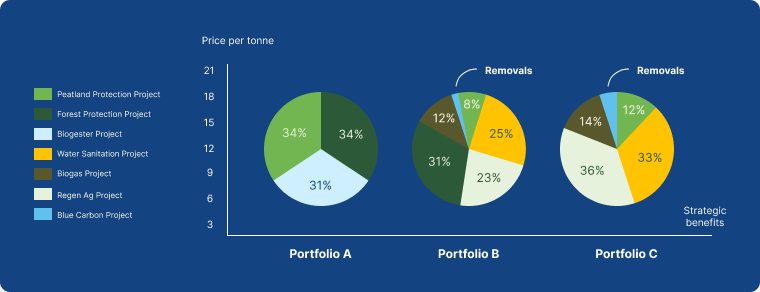
Portfolio composition often reflects trade-offs between cost, volume, time horizon, and strategic objective. Some companies may emphasise lower-cost avoidance credits to cover larger volumes, while also including removals or other project types for diversification or longer-term goals. Others may separate portfolios by reporting need, geography, or business unit.
The example below shows how different portfolio mixes can reflect different priorities across a programme. A portfolio approach helps procurement stay aligned with reporting needs, operational realities, and longer-term climate objectives, rather than treating each transaction as a standalone decision.
Step 3 — Choosing your sourcing pathway
With the procurement strategy defined, the next step is deciding how carbon credits or RECs will be sourced from the market. There is no single optimal pathway. The right route depends on the five dimensions of your procurement strategy, and many buyers use a mix of pathways across different transactions or programmes. The sourcing pathway will also affect how much price visibility they have at the point of execution.
Exchanges & trading platforms
Exchanges give buyers access to listed supply at transparent, observable prices, typically through standardised contracts and centralised market infrastructure. The main advantages are price transparency, execution speed, and a clear audit trail, which make this pathway well suited to buyers who have already defined their procurement criteria and want to transact quickly without running a full tender process.
Request for Proposals (RFPs)
An RFP is a structured competitive process in which a buyer defines its requirements and invites suppliers to respond. This pathway is useful for larger or multi-year programmes where governance, documentation and comparability matter as much as price. RFPs also create a documented rationale for supplier selection, which carries growing weight as climate claims face greater scrutiny.
Exchanges & trading platforms
OTC (Over-the-Counter) transactions are bilateral negotiations conducted directly between buyers and sellers, offering maximum flexibility for bespoke terms and non-standard projects. While this pathway allows for highly customised delivery schedules, it requires greater due diligence due to lower price transparency and a heavier reliance on counterparty reliability compared to standardised platforms.
Summary Table
| Channel | Intent | Key advantage |
|---|---|---|
| Exchange | Efficiency & liquidity | Instant liquidity and standardised, cleared contracts. |
| RFPs | Diligence & governance | Best for high-volume, multi-year purchases with stricter requirements. |
| OTC | Customisation | Access to “boutique” projects. |
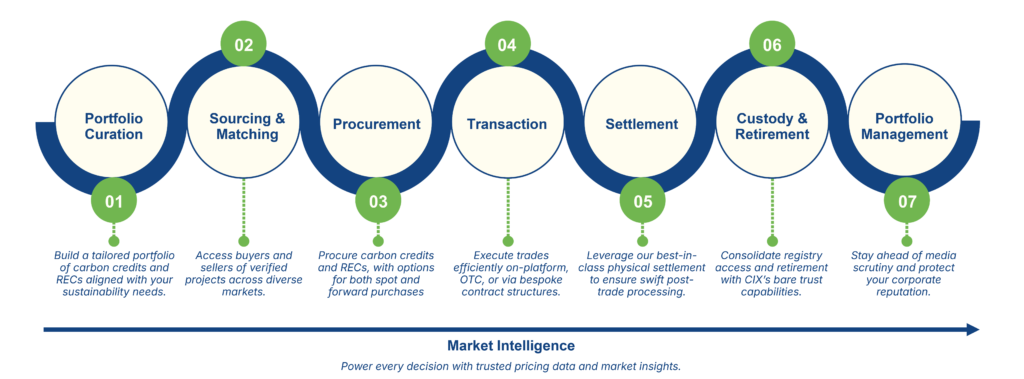
Buyers may use any of these three pathways depending on their procurement objectives, governance requirements, and the type of supply they are seeking. Across them, CIX can support different parts of the journey — from providing one-stop market access to portfolio curation, flexible procurement, settlement, holdings management, and retirement support.
Step 4 — Execute and settle
Agreeing commercial terms is only part of execution. Buyers also need to determine how the trade will be processed, how settlement will occur, and where holdings will sit once the transaction is complete.
Execution can take place through both online and offline workflows depending on the transaction type and buyer preference. A buyer may negotiate terms through an RFP or bilateral process and still use a market platform or service provider for post-trade handling. Alternatively, the full workflow may be managed on-platform.

Online, or on-platform execution
For buyers transacting on-platform, execution is typically more integrated, combining price discovery, trade submission, settlement tracking and holdings management within a single destination. On CIX Exchange, for example, buyers can access both single-project listings and standardised contracts, track settlement status and submit trades for clearing through the platform. CIX Exchange also supports bids and offers on projects without pre-funding or committing capital upfront, giving buyers more flexibility in how you manage execution. An online workflow can support:
- discovery of listed projects and products
- price visibility before execution
- direct interaction with counterparties
- trade submission and settlement tracking
- holdings management after transaction
Offline execution and post-trade support
For buyers sourcing through RFPs or bilateral / OTC transactions, execution may begin offline through structured tenders or direct negotiations. In these cases, post-trade support becomes just as important as the commercial negotiation itself. Settlement, delivery and holdings management still need to be handled in a way that reduces operational friction and creates a clean record of the transaction. This means a buyer may use one pathway to source supply and another to complete or manage the trade operationally. For example, a purchase negotiated offline may still be settled, held or prepared for retirement through a third-party market infrastructure or service provider.
Well-designed execution processes shorten timelines, reduce manual handoffs, and make it easier to maintain a clear audit trail from trade agreement through to final use.
The sourcing pathway also shapes how buyers discover and validate price: screen-based trading offer observable market prices, while RFPs and bilateral transactions rely more on quoted offers, negotiated terms, and internal benchmarking. Once the right supply has been identified and commercial terms agreed, the next phase is execution.

Step 5 — Retire, document and report
Validating a climate claim requires a rigorous audit trail to satisfy internal reviewers and external auditors. Every asset must be:
- Retired correctly within the appropriate registry.
- Documented clearly with linked contract and settlement records.
- Aligned to the relevant reporting period and use case.
Centralised management with CIX
CIX executes this end-to-end workflow for buyers, from transaction settlement to registry retirement and documentation. By providing a single point of access to 12+ registries, CIX centralises post-trade management across diverse project types, eliminating the need to manage separate registry accounts and ensuring all reporting requirements are met.
CIX Exchange
Experience a smarter, more flexible transaction platform, built to meet your evolving needs.
CIX is equipped to support your procurement journey.
Speak to us and we’ll design your best path forward with one of our experts.
Procuring in Asia
Asia presents one of the most varied procurement landscapes globally. There is no single regional carbon or REC market unlike the consolidated markets seen in Europe. Asia requires navigating a “patchwork” of national regulations, varying certificate systems, and differing levels of market maturity.
Carbon
For carbon, the first distinction is use case. Voluntary procurement is generally more flexible than compliance procurement, but compliance rules matter where they apply. In Singapore, for example, carbon tax-liable facilities may use eligible international carbon credits for up to 5% of taxable emissions. That creates a practical split between credits bought for voluntary claims and credits bought for regulated use, with different eligibility rules, documentation requirements and timelines.
For many Asian companies buying in the voluntary carbon market (VCM), the bigger pain points are often commercial and operational. A large share of VCM transactions operate privately which can undermine price discovery, making it difficult for buyers to benchmark quotes or build a repeatable, standardised process.

RECs
RECs often present a steeper hurdle than carbon. Because alignment with RE100, Scope 2 GHG Protocols or SBTi depends on strict geographic “market boundaries,” procurement must be highly localised to the point of consumption.
- Asia is not a single certificate market. Southeast Asia relies heavily on the I-REC system, though Singapore and the I-TRACK Foundation are currently developing a cross-border framework to address tracking issues. Meanwhile, China utilises GECs and Japan uses domestic Non-Fossil Certificates.
- Procurement in Asia cannot be a uniform regional purchase but designed as a market-by-market programme with centralised control. For companies aligned to frameworks, the priority is ensuring that purchases are geographically eligible across multiple jurisdictions.

Market Intelligence
Whether you are setting an internal carbon shadow price, benchmarking a bilateral quote, or deciding when to enter the market for a large programme, price intelligence is a material input to the decision.
CIX reports on traded prices from our exchange venues and across the broader voluntary carbon markets on a daily basis via Carbon Daily. We also publish on a quarterly and yearly basis: The Market Pulse series. These reports give corporate buyers a structured view of price movements by project type and our benchmarks contracts — the same price data that traders and intermediaries use when pricing trades. Access to this information levels the playing field for corporate buyers who are not in the market every day.

Tapping into pricing intelligence gives you a procurement edge
In practice: Industry spotlight & case studies
Procurement strategy looks different depending on your sector, geography, regulatory exposure, and the maturity of your internal climate programme. The resources below illustrate how companies across different industries have approached carbon credit and REC procurement. This gallery grows as CIX publishes new sector insights.


The following section highlight two case studies of companies advancing their sustainability strategies through the procurement of both carbon credits and RECs.
Lenovo’s path to carbon neutrality through ambitious emissions targets and environmental product investments

Lenovo has committed to reducing total greenhouse gas (GHG) emissions by 90% by 2050, with the remaining 10% to be neutralised through carbon capture or reforestation. By 2030, the company aims to cut its absolute Scope 1 and Scope 2 GHG emissions—those related to its direct operations—by 50%, using FY2018/19 as the base year.
Product Carbon Offset Programme. To complement its internal sustainability efforts, Lenovo launched the CO₂ Offset Services programme, allowing customers to offset the carbon footprint of their Lenovo purchases. The programme gained significant traction, with over 1 million tCO₂e offset from Think PC purchases in 2022 alone.
Renewable Energy Certificates (RECs). To reach its goal of sourcing 90% renewable electricity by 2026, Lenovo purchases RECs, I-RECs, GOs, and NFCs in regions where onsite generation isn’t economically viable. In FY2023/24, these investments supported wind and solar projects across seven countries on three continents.
Samsung’s dual-division climate strategy uses carbon credits and RECs to advance toward 2050 net zero goals
Samsung operates two independently managed divisions—Device eXperience (DX), focused on finished products, and Device Solutions (DS), focused on semiconductors. The company sees carbon credits as a key tool in its climate strategy and has committed to achieving net zero emissions by 2050, with the DX division targeting net zero by 2030.
Carbon Offset Strategy. As part of its journey toward net zero emissions by 2030, Samsung strategically purchases carbon credits from social impact projects. In 2023, the company secured 250,000 tonnes of credits from agroforestry and mangrove initiatives in Asia. These purchases complement its emissions reduction efforts and help hedge against carbon price volatility.
Renewable Energy Strategy . Samsung uses RECs in regions where direct renewable energy sourcing is not feasible, supporting its goal of achieving 100% renewable energy across all sites by 2027. The company has achieved complete renewable transitions at subsidiaries in the US, Europe, India, Vietnam and China through a combination of RECs, Power Purchase Agreements (PPAs) and on-site generation. Notably, its manufacturing site in Mexico demonstrates Samsung’s rapid progress, expanding from just 4% renewable energy in 2020 to 70% in 2023.

https://investor.lenovo.com/en/sustainability/sustainability_reports.php
https://news.lenovo.com/pressroom/press-releases/co2-offset-services-surpasses-1-million-metric-tonnes-sustainability-practices/
https://support.lenovo.com/sg/en/solutions/ht513137-projects-supported-by-lenovos-carbon-compensated-program
https://www.samsung.com/global/sustainability/media/pdf/Samsung_Electronics_Sustainability_Report_2024_ENG.pdf?msockid=10d1a77b0cd5650012e9b2120d7964af
GET IN TOUCH
Leave us your contact details, and we’ll be in touch.
Corporate Buyer Form
"*" indicates required fields