








At first glance, Guarantees of Origin (GOs) appear broadly harmonised across Europe. They follow the European Energy Certificate System (EECS) rulebook operated by the Association of Issuing Bodies (AIB), and each certificate represents 1 megawatt hour of renewable electricity with a standard set of attributes.
However, the registries behind those certificates do not all operate in the same way. National rules vary on who can hold accounts, who is allowed to cancel certificates, how long they remain valid and, increasingly, which energy carriers they cover.
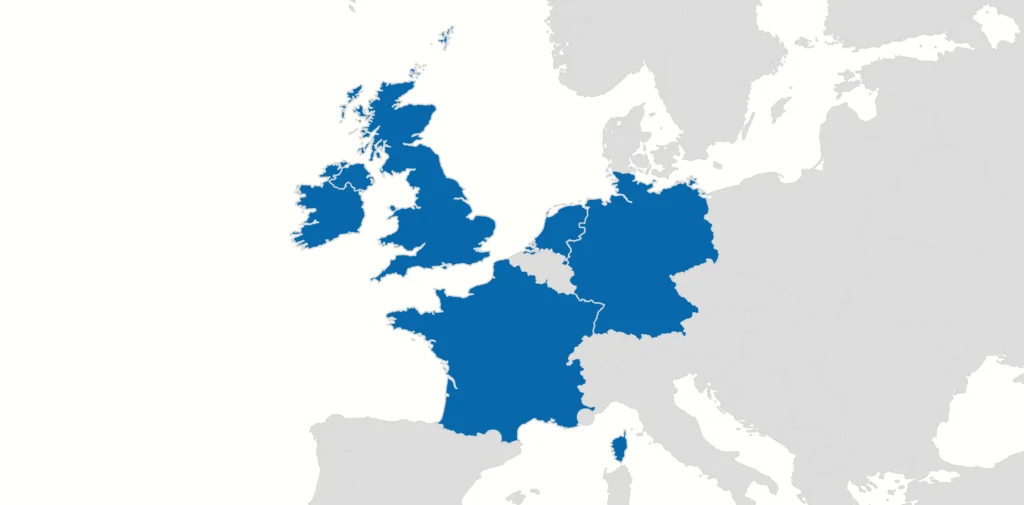
For companies reporting under CSRD and the GHG Protocol Scope 2 Guidance, these differences have practical implications. Registry-level rules can shape what is operationally feasible, what is auditable and how procurement processes need to be structured market by market. To show how that plays out, this article looks at the United Kingdom, France, Germany, Ireland and the Netherlands – five markets that highlight how registry rules can vary across Europe.
For a broader overview of how these issues fit into European EAC procurement strategy, see our guide.
The UK: Renewable Energy Guarantees of Origin
In the United Kingdom, the equivalent instrument is Renewable Energy Guarantees of Origin (REGOs), administered by the Office of Gas and Electricity Markets (Ofgem). REGOs look similar to EU GOs, but since Brexit they sit outside the AIB framework. They are not transferred through the AIB Hub, and EU GOs cannot simply be imported into the UK registry for UK Fuel Mix Disclosure.
For buyers operating across both the EU and UK, this creates two parallel certificate environments that may look similar but do not interact. Internal tracking, contractual language and audit evidence need to distinguish clearly between GOs and REGOs to avoid misstating market‑based Scope 2 figures.
Germany: supplier-led cancellation through HKNR
Germany’s GOs system is managed through the Herkunftsnachweisregister (HKNR), operated by their Federal Environment Agency.
Registry participation is primarily for authorised market actors such as generators, suppliers and certain traders, rather than end‑consumers. As a result, cancellation is often supplier-led, limiting how far central procurement teams can control timing and execution directly. For corporate buyers, Germany is a reminder that Scope 2 strategy must align with how local suppliers operate, not just with an internal reporting calendar.
France: monthly matching
In France, electricity GOs are issued under state authority and operated by EEX (European Energy Exchange) following the AIB framework but applies a stricter approach to timing.
French GOs are issued by month of production and, critically, are required to be cancelled against consumption in the corresponding month. In other words, June consumption is expected to be backed by June generation.
The implication for buyers is that a policy of cancelling all GOs at year‑end for the previous year’s consumption is not sufficient in France, even if that looks acceptable in a consolidated ESRS E1‑6 disclosure. Processes need to work at month level to keep French evidence consistent with national practice and to satisfy auditors testing temporal matching.
The Netherlands: monthly certificates, one-year validity
The Dutch GO system is operated by the national registry VertiCer B.V. Here, each certificate is linked to a specific calendar month of production, so the registry record shows exactly when the underlying electricity was generated.
Dutch rules allow GOs to be cancelled for disclosure up to 12 months after the end of that production month. After that point, they expire and can no longer be used. For buyers, that creates a clear deadline: there is approximately a one-year window from the end of each production month to cancel Dutch GOs, and any certificates left unused beyond that point are lost for disclosure purposes.
Ireland: electricity GOs today, gas GOs emerging
Ireland implements GOs through its EECS Electricity Domain Protocol administered by the Single Electricity Market Operator (SEMO) for all‑island market, aligning with the AIB framework.
At the same time, Ireland is developing a gas GO framework for biomethane, with the Commission for Regulation of Utilities (CRU) acting as regulator and Gas Networks Ireland (GNI) appointed as the issuing body for the electronic registry. Under that framework, biomethane producers injecting into the network will receive gas GOs, which can then be traded between market participants. For now, only licensed suppliers will be able to cancel those certificates when making renewable gas supply claims to customers.
If biomethane forms part of an Irish decarbonisation strategy, buyers may need to track electricity and gas certificates through related but distinct systems, each with its own participants, rules and cancellation responsibilities.
Cross-border use of GOs
Whilst differences across registries country-by-country constraints, GOs can be procured anywhere (within the AIB network). However, cancellation needs to be executed in the country of consumption. While GOs are freely tradable across AIB markets, they cannot simply be cancelled in the country where they are cheapest and applied elsewhere. Under EECS rules, certificates must be transferred via the AIB Hub into the registry corresponding to the country of consumption before cancellation.
This means that while procurement can be centralised and cost-optimised across Europe, cancellation, and therefore disclosure, remains locally anchored. Ignoring this distinction can lead to invalid claims under EECS, RE100, and audit frameworks.
Why these differences matter for your procurement strategy
As the cross-border rules illustrate, the GO concept is harmonised, but application is shaped by national implementation details. For multinational buyers, those details directly shape alignment between internal Scope 2 strategies and what national registries and auditors recognise.
Three practical takeaways stand out:
- Design timing around the strictest rule you face. France’s monthly matching for example, Germany’s 18‑month cancellation limit and Dutch one‑year window mean internal processes should assume tight horizons everywhere, not just in individual markets.
- Be explicit about who cancels where. In some systems, buyers can play a more direct role. In others, suppliers or authorised intermediaries sit at the centre of the process. That should be reflected in contracts, controls and internal ownership.
- Track how GOs expand beyond electricity. Ireland’s gas GOs and similar developments elsewhere show that gas and other energy carriers are gradually being pulled into the same evidentiary framework as electricity GOs.
Understanding these registry‑level dynamics allow a pan‑European GO strategy to remain simple for internal stakeholders while still standing up under CSRD, GHG Protocol, RE100 and Science Based Targets initiative (SBTi) scrutiny.
For companies buying across multiple countries, it helps to work with a partner that understands those registry nuances – from procurement and cancellation through to documentation and reporting. CIX supports corporates in navigating these complexities with the market access and execution support needed for audit-ready EAC strategies.
Who We Serve
Solutions designed for different needs

For Corporate Buyers
Buy and retire verified carbon credits and RECs with flexible procurement and deep market expertise to support sustainability goals.

For Traders & Intermediaries
Enhance trade execution and liquidity through robust market infrastructure and efficient settlement with a broad counterparty network.

For Project Suppliers
Tap into a global network of buyers to secure spot or forward demand, while ensuring fair pricing for carbon credit and REC projects.
get started on gos
Ready to navigate the complexities of GOs?
Leave us your contact
details, and we’ll be in touch.
General Contact Us
"*" indicates required fields