








The Science Based Targets initiative (SBTi)’s Version 2.0 of its Corporate Net-Zero Standard formalises a dual target structure, sharpens eligibility criteria for Energy Attribute Certificates (EACs) such as RECs, and introduces geographic and temporal matching requirements. For companies in Asia with SBTi-aligned targets that rely on RECs for scope 2, this raises questions about how existing strategies hold up – all of which play out differently across Asia’s fragmented registries and grid structures compared to other regions.
In a webinar hosted by Climate Impact X (CIX), Gaurav Julka, Director of Client Development, broke down what this means for companies already committed to SBTi targets and those preparing a first submission.
Want to rewatch the full webinar recording and refer to the presentation slides? Find them at the end of this article.
Five key takeaways from the session:
1. A strict implementation hierarchy now governs REC use
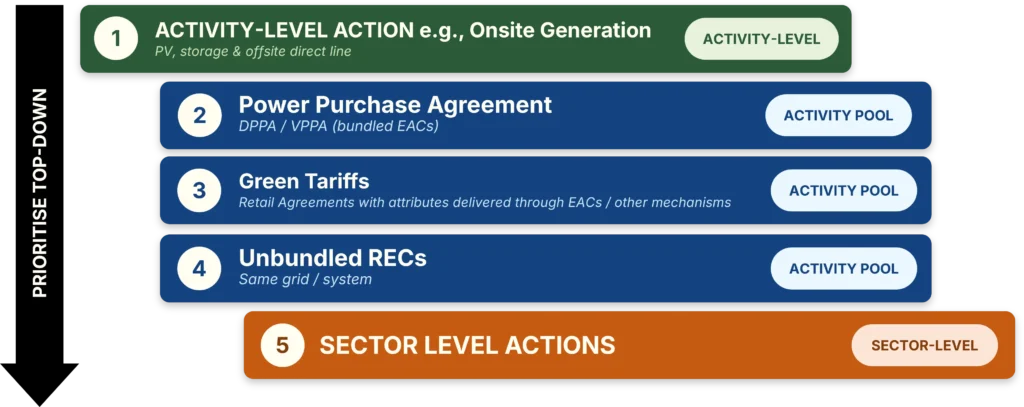
Companies need to work on a top-down approach: they must exhaust activity-level actions (like on-site solar or direct line from an asset exclusive to you) before turning to activity-pool options such as Power Purchase Agreements (PPAs), green tariffs or unbundled RECs, and only move to sector-level actions as a last resort. Gaurav noted that price “cannot be the only reason” for skipping to sector-level actions – other factors must justify the decision, and this must be disclosed.
2. “Near, new, now” is the new benchmark for REC eligibility
All of these activity-pool instruments (PPAs, green tariffs and unbundled RECs alike) remain fully eligible under V2.0, but each must now clear an integrity test built around three pillars.
- Near refers to geographic matching: single-grid markets, mostly across ASEAN, require sourcing from the same market, while complex grids like China, India and Australia demand proof of deliverability within specific grid boundaries, with cross-border sourcing allowed only where transmission rights are demonstrated.
- New requires RECs to come from relatively recent capacity, enforced through a 15-year generator commissioning or repowering limit plus additional third-party assurance for biomass and biogas assets
- Now covers temporal matching: vintage windows are tightening from 21 months to 12 months as a baseline, while large consumers face growing pressure toward real-time, hour-by-hour matching.
3. 24/7 hourly matching complexity varies sharply by procurement type
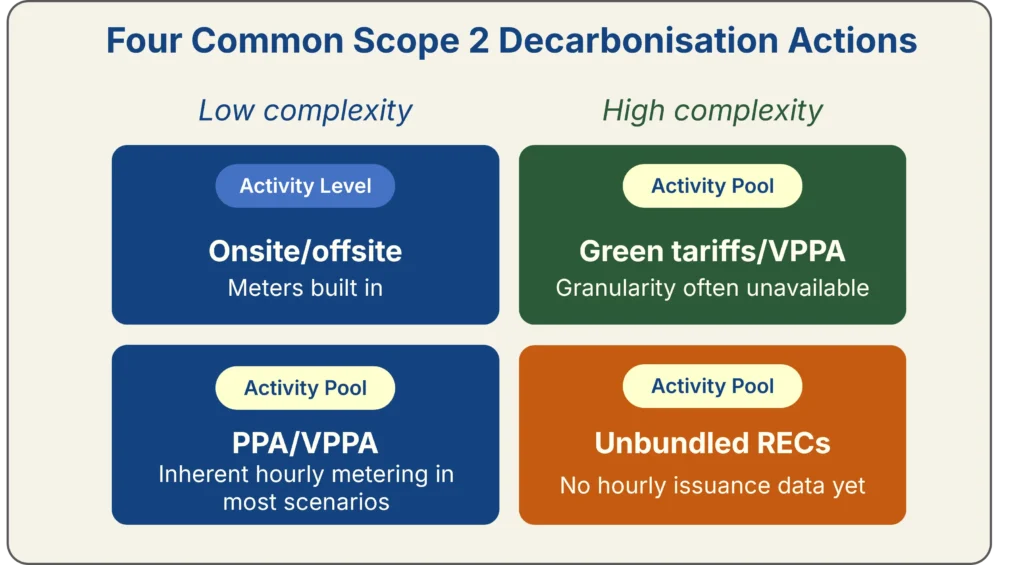
Gaurav mapped out a “complexity quadrant”: on-site/offsite generation and single-asset PPAs offer low-complexity hourly matching since metering already exists, while aggregated green tariffs, Virtual PPAs (VPPAs) and unbundled RECs face real hurdles as most registries only issue certificates monthly or quarterly. No registry currently offers hourly issuance – Taiwan is the exception, going down to 15-minute intervals. Elsewhere, companies have to manually match consumption data from their sites against energy production using third-party software and assurance.
Moreover, large consumers – those using more than 10 gigawatt-hours in a single market – also face a new requirement: reporting their hourly matching percentage, which SBTi is signalling as the direction of travel even if it isn’t a compliance threshold yet.
4. Market access varies by registry, and compliance nuances matter
Corporates sourcing EACs across Asia will need to navigate multiple registries, each with its won rules. Gaurav flagged Japan’s Green Energy Certificates (GECs) and Non-Fossil Certificates (NFCs) specifically as requiring dedicated compliance knowledge, on top of the more familiar I-REC system used across much of the region. Where local supply is insufficient – a live issue in markets like Singapore – companies can fall back on sector-level actions, but only with clear disclosure.
5. A single-source strategy won’t cut it – portfolio thinking is essential
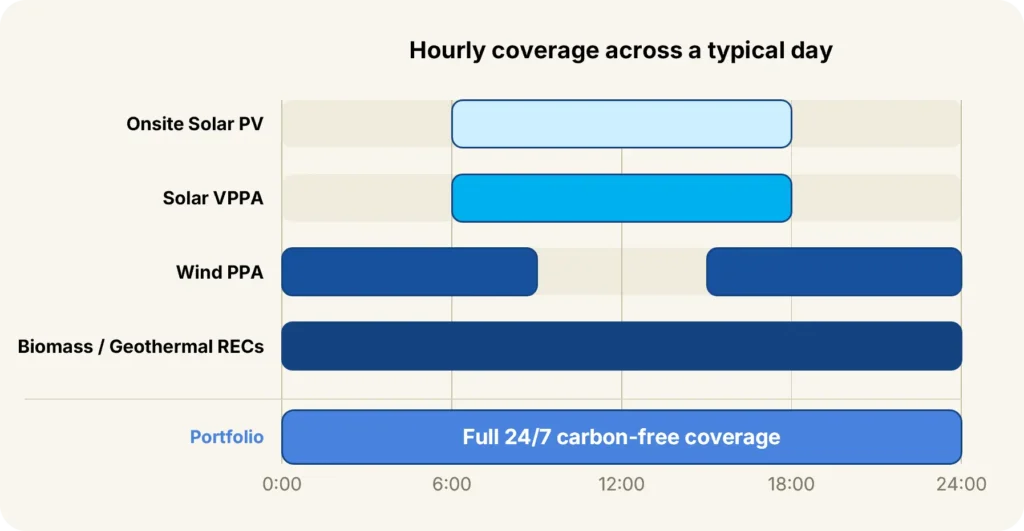
Since most renewable energy in Asia comes from solar or wind, companies with night-time or round-the-clock operations will need to fill the gaps with other technologies, such as biomass or geothermal RECs.

Layered on top of this is a five-dimensional procurement decision: bundled versus unbundled, geographic matching, additionality, temporal matching, and technology portfolio mix – blending solar and wind with sources like biomass or geothermal to cover round-the-clock operations.
At CIX, we help clients who are aligned with SBTi build the right portfolio covering these dimensions in mind.
A voluntary shift, but early movers gain the edge
Switching to V2.0 is not mandatory for every company right away – it depends on when your near-term target is due for refresh, and Version 1.0 remains usable through the end of 2027. Even so, getting ahead of the curve on “near, new, now,” particularly the implementation hierarchy and integrity criteria, is worth doing before validation checks begin.
Want to explore how CIX can support your EAC procurement and SBTi alignment strategy? Connect with us at contact.us@climateimpactx.com to get started.
For further reading, head to our corporates or perspectives page.
See webinar presentation slides here.
Let’s Connect
Align your EAC strategy with SBTi V2.0. Let’s connect!
Corporate Buyer Form
"*" indicates required fields